

Urea Fertilizer Market to Reach US$ 111.2 Bn by 2033 Fueled by Rising Global Food Demand and Expanding Cereal Production
Urea Fertilizer Market
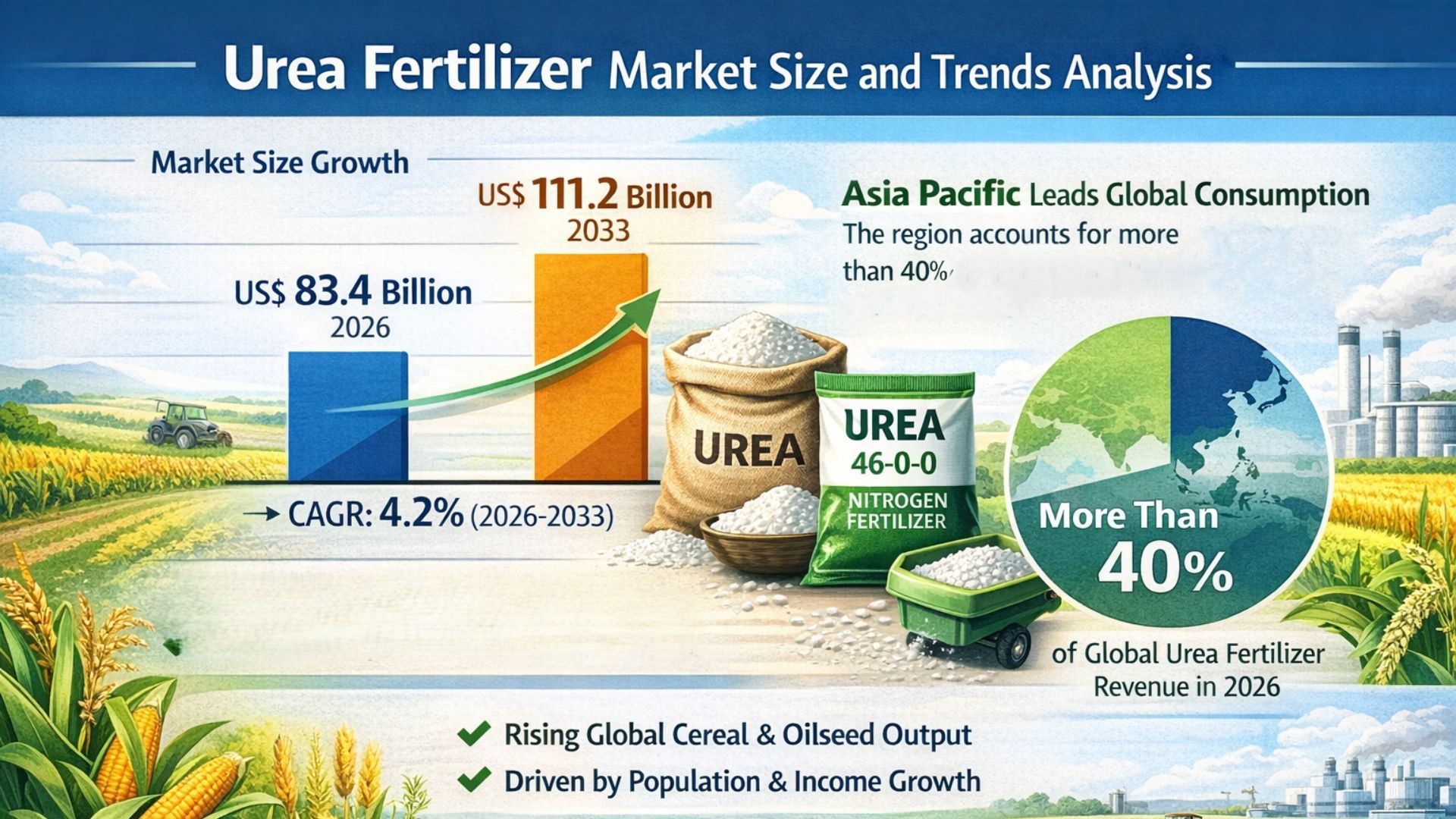
Asia Pacific dominates global consumption, accounting for over 40% of global urea fertilizer revenue in 2026
LONDON, LONDON, UNITED KINGDOM, March 16, 2026 /EINPresswire.com/ -- The global Urea Fertilizer Market is poised for steady growth as agricultural productivity remains a critical priority across both developed and developing economies. According to the latest study by Persistence Market Research, the global urea fertilizer market size is likely to be valued at US$ 83.4 billion in 2026 and is projected to reach US$ 111.2 billion by 2033, growing at a CAGR of 4.2% between 2026 and 2033. The market expanded from US$ 67.5 billion in 2020, reflecting a historical CAGR of 3.6%, supported by rising cereal and oilseed output and intensifying nutrient use in major producing economies. As global food demand continues to rise alongside population growth, the use of nitrogen-based fertilizers such as urea is expected to remain vital for improving crop yields and maintaining soil fertility.
Get Your FREE Sample Report Instantly – Click Now: https://www.persistencemarketresearch.com/samples/36311
Rising Global Food Demand Driving Fertilizer Consumption
One of the primary drivers of the urea fertilizer market is the growing global demand for food production. Rapid population growth and changing dietary patterns are placing increasing pressure on agricultural systems to produce higher yields from limited arable land. Urea fertilizer, known for its high nitrogen content and cost efficiency, remains one of the most widely used nitrogen fertilizers worldwide. Farmers increasingly rely on urea to enhance crop productivity, particularly for staple crops such as wheat, rice, and maize. As food security becomes a global priority, governments and agricultural organizations are encouraging the use of balanced fertilization practices, further supporting the market’s growth.
Expanding Cereal and Oilseed Cultivation
Cereal and oilseed production continues to expand across several regions, especially in Asia Pacific and Latin America. These crops require substantial nitrogen inputs during key growth stages, making urea fertilizer an essential component of modern farming practices. Increasing consumption of cereals and edible oils, combined with rising export demand, is encouraging farmers to invest in fertilizers to improve crop quality and yield. As a result, the demand for urea fertilizers is expected to remain robust in major agricultural economies.
Technological Advancements in Enhanced Efficiency Fertilizers
Innovations in fertilizer technology are also shaping the future of the urea fertilizer market. Manufacturers are increasingly developing coated and stabilized urea formulations designed to improve nitrogen use efficiency and reduce nutrient losses. Controlled-release fertilizers help minimize nitrogen leaching, volatilization, and environmental pollution while providing sustained nutrient availability to crops. These advancements are gaining popularity among farmers seeking cost-effective solutions that improve productivity while complying with environmental regulations.
Growth of Precision Agriculture and Smart Farming
The increasing adoption of precision agriculture is transforming fertilizer application practices. Modern farming technologies, including GPS-guided equipment, soil nutrient sensors, and satellite monitoring systems, enable farmers to apply fertilizers more efficiently and accurately. Precision farming allows optimal fertilizer dosage, reducing waste and maximizing crop yields. As agricultural technologies continue to evolve, urea fertilizer manufacturers are aligning their products with advanced farming practices to support sustainable and efficient crop management.
Rising Adoption of Fertigation and Foliar Spray Techniques
Another notable trend in the urea fertilizer market is the increasing use of fertigation and foliar spray application methods. Fertigation, which involves applying fertilizers through irrigation systems, ensures uniform nutrient distribution and improves nutrient absorption by crops. Foliar spraying, on the other hand, allows rapid nutrient uptake through plant leaves, particularly during critical growth stages. These methods are gaining traction in high-value crop cultivation such as fruits, vegetables, and horticultural crops, further contributing to the demand for liquid and specialized urea fertilizers.
Get a Customized Market View in One Click: https://www.persistencemarketresearch.com/request-customization/36311
Government Subsidies and Agricultural Support Programs
Government initiatives and subsidy programs are playing a crucial role in promoting fertilizer consumption across several countries. Many governments provide financial incentives and subsidies to farmers to ensure affordable access to fertilizers and support agricultural productivity. In countries with large farming communities, such policies have significantly boosted the consumption of urea fertilizers. Additionally, national agricultural policies aimed at enhancing crop output and ensuring food security are further strengthening the market outlook.
Expanding Distribution Networks and Digital Platforms
The expansion of fertilizer distribution networks is improving accessibility for farmers in both rural and remote regions. Agricultural cooperatives and retail fertilizer stores continue to serve as primary distribution channels for urea fertilizers. Meanwhile, the emergence of online agricultural platforms is transforming the fertilizer supply chain by enabling farmers to purchase agricultural inputs digitally. These platforms offer convenient ordering, competitive pricing, and access to agronomic advisory services, making fertilizer procurement more efficient and transparent.
Market Segmentation
By Product Type
Granular Urea
Coated / Stabilized Urea
Prilled Urea
Liquid Urea
By Application
Soil Application
Fertigation
Foliar Spray
By Crop Types
Cereals & Grains
Pulses, Oilseeds, and Fodder Crops
Horticultural Crops (Fruits & Vegetables)
Plantation Crops
Others
By Distribution Channel
Agricultural Cooperatives
Online Agricultural Platforms
Retail Fertilizer Stores
Direct Sales to Farmers
Others
By Region
North America
Europe
Asia Pacific
Latin America
Middle East & Africa
Regional Outlook and Market Opportunities
Asia Pacific is expected to remain the largest and fastest-growing market for urea fertilizers due to its vast agricultural sector and large population base. Countries such as China and India represent significant fertilizer consumers as they strive to maintain high levels of crop production to meet domestic food demand. Government subsidy programs and strong agricultural infrastructure further support market growth in the region. North America and Europe also contribute significantly to the global market, driven by advanced farming technologies and increasing adoption of precision agriculture. Farmers in these regions are focusing on improving fertilizer efficiency while complying with strict environmental regulations.
For In-Depth Competitive Analysis, Buy Now: https://www.persistencemarketresearch.com/checkout/36311
Company Insights
✦ Yara International ASA
✦ Nutrien Ltd.
✦ CF Industries Holdings, Inc.
✦ Qatar Fertilizer Company (QAFCO)
✦ SABIC Agri-Nutrients
✦ EuroChem Group AG
✦ OCI N.V.
✦ Acron Group
✦ Pupuk Indonesia (Persero)
✦ CNPC / PetroChina
✦ Indian Farmers Fertiliser Cooperative Ltd. (IFFCO)
Explore the Latest Trending Research Reports:
• Shape Memory Alloys Market
• Europe Silicone Market
Ajaykumar Patil
Persistence Market Research
+1 6468786329
email us here
Visit us on social media:
LinkedIn
Instagram
Facebook
YouTube
X
Legal Disclaimer:
EIN Presswire provides this news content "as is" without warranty of any kind. We do not accept any responsibility or liability for the accuracy, content, images, videos, licenses, completeness, legality, or reliability of the information contained in this article. If you have any complaints or copyright issues related to this article, kindly contact the author above.
